


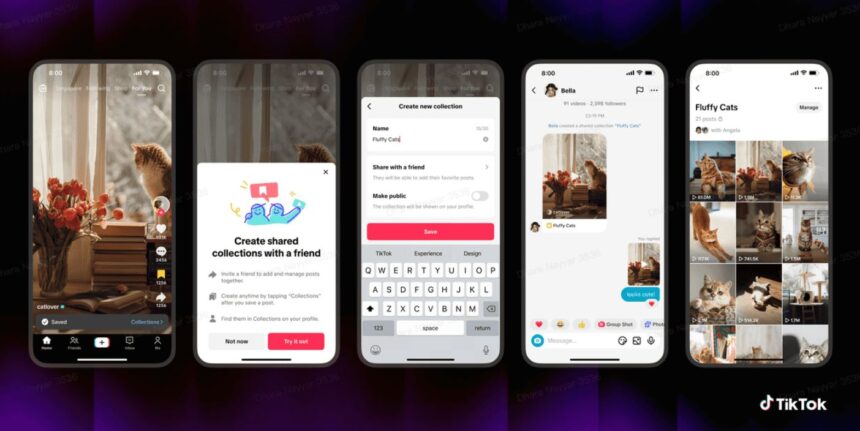
TikTok is taking a big step toward making our endlessly-personalized feeds feel a little less… lonely. In a new update, the short-form video giant is rolling out two features aimed squarely at friends and families who already spend time swapping TikTok links in their group chats: Shared Feed and Shared Collection.
Together, these tools are designed to turn solo scrolling into something collaborative, giving people a way to discover and organize content with the people they’re closest to—without leaving the app.
What Is TikTok’s Shared Feed?
For years, TikTok’s “For You” page has been about one person and one algorithm. Shared Feed tweaks that formula by creating a mini “For You” that’s built for more than one person at a time.
According to TikTok’s announcement, Shared Feed lives inside direct messages. One person sends an invitation to a friend or family member, and once that invite is accepted, the app generates a special, shared feed for that private chat. Every day, the pair will see a curated selection of 15 videos that are tailored to both of their interests, based on what they like, watch, and comment on individually.
Instead of endlessly scrolling through a continuous river of videos, Shared Feed gives you a finite batch to watch and talk about. After both people have gone through all 15 videos, they can even check a Shared Likes history to see which clips they both enjoyed. It’s all happening inside the DM thread, so reacting, debating, or laughing together is part of the experience, not an afterthought.
In simple terms, Shared Feed takes what many users already do, sending TikToks back and forth all day—and wraps it into a built-in feature with its own space and algorithm.
How Shared Collections Make Saved Videos Social
If Shared Feed is about discovering content together, Shared Collection is about saving it together. TikTok has long allowed users to save videos into private collections, whether it’s recipes, travel ideas, workouts, or DIY inspiration. Shared Collection adds a collaborative twist to that familiar feature.
To start a Shared Collection, both people must follow each other. When someone saves a video or opens their collections, they can choose to create a shared collection with a friend or family member. Once the other person accepts, both can rename the collection, add more videos, and revisit those clips whenever they want.
TikTok says Shared Collections are meant for all kinds of joint planning and inspiration, holiday gift ideas, home makeover plans, travel itineraries, new skills to learn together, or just a folder full of funny videos that two people find hilarious. The collections can stay completely private between the people involved, or they can be made discoverable to the wider TikTok community if users want others to see what they’ve curated.
Importantly, Shared Collection is rolling out globally to accounts aged 16 and up, and TikTok positions it as part of its effort to keep collaborative features within mutually trusted circles.
Collaboration, But with Limits
Both Shared Feed and Shared Collection come with a few guardrails. TikTok is keeping these features inside direct messages, which are already restricted for younger teens, and requires mutual following before a shared space can be created. That means random accounts can’t suddenly pull you into shared feeds or collection folders.
TikTok also emphasizes that all content in these shared spaces still has to follow its Community Guidelines. The experience may feel more intimate, but it’s still governed by the same rules that apply across the app.
From a design perspective, TikTok is clearly trying to balance the intimacy of private sharing with the scale of its recommendation engine. Shared Feed doesn’t replace your main For You page; it sits alongside it as a small, curated corner that belongs to you and one other person.
Why TikTok Is Doing This Now
These features don’t appear in a vacuum. TikTok has spent the last year expanding its tools for controlling what you see and how you use the app—from better topic management on the For You page to AI-powered keyword filters that let you mute content you don’t want to see.
At the same time, the way people use social apps has shifted. Users increasingly share content privately rather than posting publicly, and a lot of engagement now happens in DMs instead of comment sections. TikTok’s Shared Feed and Shared Collection take that reality and build a product around it, rather than treating private sharing as an afterthought.
It also doesn’t hurt that other platforms are experimenting in the same space. Instagram, for example, has its “Blend” feature for Reels, which creates a joint feed for two users based on their combined tastes. TikTok’s Shared Feed is clearly in the same family of ideas—but with its own spin, especially with shared metrics and the tight integration inside messaging.
The Future of “Together” Scrolling
On the surface, these are just two new features in a long list of TikTok experiments. But they hint at a bigger shift in how platforms see the future of social video.
Instead of each user living alone with their algorithm, TikTok is exploring what happens when that algorithm is shared—when feeds become something you experience with someone else at the same time, rather than something you talk about afterward. Shared Collections deepen that idea by turning saved videos into a kind of living scrapbook that two people build together over time.
Whether users fully embrace the idea of joint feeds and shared folders remains to be seen. Some people enjoy the manual act of picking out videos to send to friends one by one; others might love the convenience of opening a chat and seeing a fresh stack of 15 clips waiting for them every day.
What’s clear is that TikTok doesn’t just want to be the place where you discover content alone on your phone. With Shared Feed and Shared Collection, it’s betting that the next phase of growth will come from turning that experience into something friends and families can share, literally.